
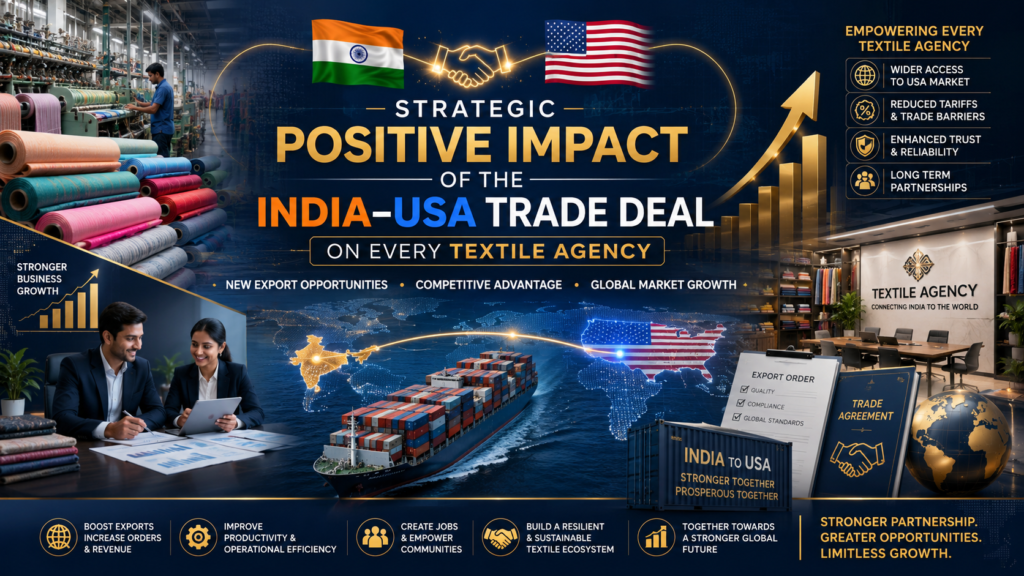
Strategic Positive Impact of the India–USA Trade Deal on Every Textile Agency
Tariffs on Indian textiles fell from 50% to 18% in a single announcement. This is the full breakdown — segment by segment, competitor by competitor — and what it means for your export business. 📅 Published: June 10, 2026 ✍️ By Rajlaxmi Textile Agency ⏱ 14–16 min read 📂 Trade & Export 📋 Contents Why This Trade Deal Changes Everything On February 3, 2026, India and the United States announced a bilateral trade framework that every agency operating in the export market had been waiting for. In a single agreement, textile tariffs that had climbed to a punishing 50% were brought down to 18%. This was not a gradual shift. It was a reset — and the textile industry felt it immediately. Throughout most of 2025, Indian exporters were fighting an uphill battle. High US tariffs had stalled orders, disrupted buyer relationships, and pushed some importers toward Bangladesh and Vietnam. The sector survived, but not without damage. A CITI survey found that US shipments fell more than 50% for roughly one in four textile exporters during that period. The February 2026 agreement restored what every buyer and seller in the textile industry needs most: predictability. Stable tariff rates allow a agency to price competitively, commit to seasonal orders, and build durable relationships with US buyers who had been cautious for months. The US market absorbs approximately 28% of India’s total textile and apparel exports — roughly $11 billion annually. Losing that market was never an option. Regaining it with a competitive tariff advantage is now a real possibility. At Rajlaxmi Textile Agency, we track every trade development that affects our clients. This article is a comprehensive analysis of what the deal means, segment by segment, and what steps the industry should take to convert this policy shift into genuine business growth. The 2025–2026 Timeline: How We Got Here Context matters. Understanding why this agreement carries so much weight requires a brief look at how trade conditions deteriorated before the breakthrough. February 2025 India and the US launch formal Bilateral Trade Agreement (BTA) talks. A agency exporting to the US is still working with regular tariff schedules at this point. April 2025 The US imposes an initial 10% reciprocal tariff on Indian goods as part of a broader push for trade rebalancing across all major partners. August 7, 2025 Tariffs on Indian products rise to 25%, creating significant uncertainty for every business in the textile industry dependent on US buyers. August 28, 2025 An additional 25% punitive tariff is imposed due to India’s purchases of Russian oil. The effective combined tariff burden on Indian textile exports reaches 50%. January 27, 2026 India concludes the India–EU Free Trade Agreement, offering immediate tariff relief in Europe and giving the textile agency exporting community a partial buffer. February 3, 2026 India and the US announce the bilateral trade framework. The new reciprocal tariff is confirmed at 18% on Indian textile products. February 6, 2026 US President Donald Trump signs an executive order eliminating the 25% oil-related penalty tariff, effective February 7, 2026. The industry begins recovering. Despite the 50% tariff environment, India’s textile exports for FY26 still reached ₹3.16 lakh crore — a 2.1% increase over the previous year. Exporters diverted shipments to the UAE (+22.3%), UK (+7.8%), Germany (+9.9%), Spain (+15.5%), and Japan (+20.6%), demonstrating the textile industry’s resilience and ability to diversify. That diversification experience will serve the agency community well as US orders now return. India’s geographic export base has strengthened — and the US market opportunity is intact. Core Terms Every Textile Agency Must Understand The India–US Bilateral Trade Agreement is moving toward a comprehensive final text. The February 2026 interim framework and joint statement set clear terms that every agency needs to know before its next buyer meeting. India now holds a lower effective US tariff rate than China, Pakistan, Bangladesh, and Vietnam — Commerce Minister Piyush Goyal, February 2026. Tariff Changes: Before and After Parameter Before the Deal (2025) After the Deal (2026) Reciprocal Tariff on Indian Textiles Up to 50% 18% Oil-Related Penalty Tariff 25% additional Eliminated Tariff on Silk Products Standard rates 0% (Zero Duty) India vs Bangladesh (US market tariff) Bangladesh: 20% India: 18%, Bangladesh: 19% Products Covered Under the Agreement Textile Categories with Confirmed Trade Benefit What India Commits in Return No trade deal comes without reciprocal obligations. India has agreed to eliminate or reduce tariffs on all US industrial goods and a broad range of US food and agricultural products. India also committed to stopping purchases of Russian oil and expanding its defense cooperation with the United States. For any textile agency working in the domestic market, these commitments may increase competition from US-made industrial inputs. However, for the export-oriented industry, the net outcome is strongly positive. What the Full BTA Could Add Later The current 18% tariff is an interim measure. The roadmap toward a comprehensive BTA targeting $500 billion in bilateral trade by 2030 includes deeper tariff cuts on labor-intensive categories, possible zero-duty access on pharmaceuticals and gems, and further rules of origin negotiations. A textile agency that establishes strong buyer relationships now will be best positioned when those further reductions come through. Segment Breakdown: Who in the Textile Industry Gains the Most The trade deal affects every part of the textile industry, but not all segments benefit equally. Understanding the opportunity by category is essential for any agency deciding where to focus its energy. Ready-Made Garments (RMG) — The Biggest Category RMG is the single largest export category, contributing 45% of India’s total textile exports in FY26 at $14.53 billion. Approximately 70% of India’s textile exports to the US fall within this category. With the tariff reduction now in place, US apparel buyers who shifted sourcing to Bangladesh or Vietnam after the August 2025 tariff spike have a strong financial case to reconsider India. Every agency serving apparel buyers should prepare revised costing proposals and proactively reach out to dormant US contacts. The pricing mathematics have changed significantly. Cotton Textiles — India’s
Strategic Positive Impact of the India–USA Trade Deal on Every Textile Agency Read More »